Holocaust Day is celebrated every year in the State of Israel in memory of the victims of the Holocaust (from the Hebrew Shoa – Catastrophe). The full name is “Yom HaShoah Ve-Hagevura” (Hebrew: “Holocaust and Heroism Remembrance Day”). The date was established by a resolution of the Knesset (Israeli Parliament) dated 12.04.1951 on the 27th day of the month of Nisan as “Day of Remembrance for the Victims of the Holocaust and the Ghetto Uprising”. The day of remembrance was not chosen by chance: between the uprising in the Warsaw Ghetto, which began on the 1st day of Pesach, and Yom HaZikaron – the Day of Remembrance of the fallen soldiers of Israel, during the traditional mourning of counting the Omer[1].
On May 3, 1951, the first commemoration of Holocaust Remembrance Day took place in the Holocaust Hall on Mount Zion, which was accompanied, in particular, by the unveiling of a bronze statue of Mordechai Anelewicz, the leader of the Warsaw Ghetto Uprising, in Kibbutz Yad Mordechai.
In order to “initiate an annual commemoration of the Catastrophe that the Nazis and their accomplices inflicted on the Jewish people, as well as the acts of heroism and uprisings that were carried out,” on April 8, 1959, the Knesset passed the Law “On the Day of Remembrance of Martyrs and Heroes.” A further amendment to the 1961 law required the closure of entertainment establishments on the eve of the commemorative date.
It is symbolic that for the first time the Day of Remembrance of the Holocaust and Heroism was celebrated in 1959 in the House of the Ghetto Fighters in Kibbutz Lochamei ha-Getaot – at that time, the first museum in the world dedicated to the Holocaust and the heroism of the Jewish people, named after Yitzhak Katznelson , a prominent Jewish poet and underground member of the Warsaw Ghetto who died in the Auschwitz death camp.
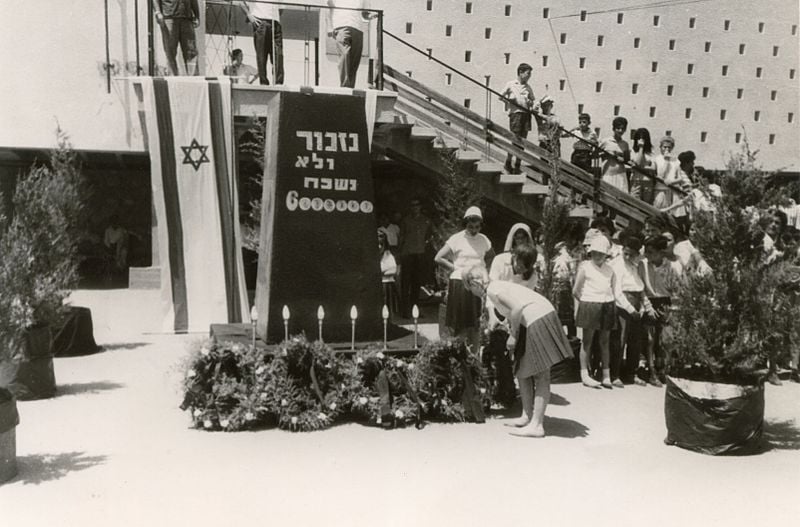
Since the early 1960s, the day of remembrance in Israel has followed a certain unchanging structure. The central ceremonies in the evening and the following morning are held at the state-run Yad Vashem National Memorial to Disaster and Heroism and are broadcast live. In the presence of the country's highest officials, the victims and their relatives gather with the general public to take part in a memorial ceremony in which six torches are lit in memory of the 6 million Jews killed between 1939 and 1945. The next morning, the ceremony at Yad Vashem begins with a two-minute sound of a siren that resounds throughout the country. Currently, any work is stopped; people walking along the streets stop; cars pull to the side of the road, showing respect for the dead. In addition to the memorial center, ceremonial events take place in other educational and educational institutions in Israel. Any radio and television programs on this day are mostly devoted to the fate of the Jewish people during the Holocaust, such as personal interviews with survivors, etc.
This commemorative day is of great importance for Israelis and the Jewish people in general around the world because the importance of preserving the memory of the victims of the Catastrophe in times of challenges, especially for the State of Israel, is quite clear.
Museum “Jewish Memory and Holocaust in Ukraine” joins the Memorial Day. We remember. never againу. לעולם לא עוד
Iryna Radchenko
[1] According to the Torah, the obligatory oral counting of 49 days must be done between Passover and Shavuot. This countdown symbolizes the spiritual preparation and anticipation of the gift of the Torah given by G-d at Mount Sinai at the beginning of the month of Sivan (note).